Elizabeth Anscombe
May 10, 2026
First Aired: January 13, 2025
Listen


Elizabeth Anscombe made hugely influential contributions to contemporary action theory, moral theory, and philosophy of mind. She also famously protested Truman’s decision to drop the atomic bomb when he was awarded an honorary degree at Oxford. Josh and Ray explore her life and thought with Rachael Wiseman from the University of Liverpool, co-author of Metaphysical Animals: How Four Women Brought Philosophy Back to Life.
Part of our Wise Women series, generously supported by a grant from the National Endowment for the Humanities.
Ray Briggs
What’s the difference between a killing and a murder?
Josh Landy
Is there ever such a thing as unintended consequences?
Ray Briggs
If you intend to cook, do you also intend the dirty dishes?
Josh Landy
Welcome to Philosophy Talk the program that questions everything.
Ray Briggs
…except your intelligence. I’m Ray Briggs.
Josh Landy
And I’m Josh Landy. We’re coming to you via the studios of KALW San Francisco Bay Area.
Ray Briggs
Continuing conversations that begin at philosophers corner on the Stanford campus, where Josh teaches philosophy.
Josh Landy
And at the University of Chicago where Ray teaches philosophy.
Ray Briggs
Today it’s the next episode in our “Wise Women” series, generously supported by a grant from the National Endowment for the Humanities. We’re exploring the life and thought of Elizabeth Anscombe.
Josh Landy
Anscombe is such an interesting figure and a hugely important philosopher from the 20th century. She worked on so many different topics, history, metaphysics, religion, language, maybe above all, she was a pioneering figure in the philosophy of action.
Ray Briggs
Yeah, that’s an area of philosophy that asks questions like, what’s the difference between doing something on purpose and just having it happen?
Josh Landy
Right, like if you’re on a subway train and there’s a sudden jolt and and some guy bumps into you, you’re not going to be that fussed about it. But if the train’s standing still at the station and he bumps into you on purpose, that’s a whole different story.
Ray Briggs
Those two things are really different. And you know, Josh, I can tell you exactly what the difference is. If he does it on purpose, he’s there, thinking to himself, I don’t like that guy. I’m gonna bump into him. Hey, he probably read your book on Proust.
Josh Landy
Well, if it’s about my Proust book, then I guess, fair enough. You know, what am I gonna say? Back to that, but the way you describe it, I don’t know. It seems a little misleading to me. I mean, you imagine this guy forming a sentence in his head about how much he hates me and loads my book. Is that how it actually is in real life, we don’t go around speaking sentences to ourselves all the time. I’m gonna make a cup of tea. I’m gonna think about Anscombe. I’m gonna say something to my friend Ray.
Ray Briggs
Okay, the thought doesn’t have to be in words, but there does have to be a thought, right? That’s what distinguishes the guy who hates your chapter on the Madeleine from the guy who’s just thrown into you by a bumpy bit of track.
Josh Landy
Okay, but, but now, imagine there’s someone else on the train. She’s in a hurry to get to an interview, and as soon as the train stops, she rushes out the door, bumping into me on the way. So, so the Proust hater guy was aggressive on purpose, but, but how about her? Did this nice person intend to bump into me?
Ray Briggs
Well, yes, obviously, she moved her body through space in a particular trajectory, and that trajectory collided with your body. And what’s more, she followed that trajectory deliberately. So, yes, she deliberately ran into you.
Josh Landy
Oh, okay, so here’s where Anscombe has a really cool insight. She says there are lots of different ways of describing the same action, and whether or not you did something intentionally depends on how you think about so. So take her most famous example, a bloke is putting water into a well, and that water goes into a house.
Ray Briggs
Okay, sounds like a helpful guy.
Josh Landy
But you haven’t heard the whole story. Turns out that water is poisoned. Oh, sounds like an unhelpful guy, yeah, but hang on, the people in the house are Nazis.
Ray Briggs
Oh, okay, now I’m just confused.
Josh Landy
All right, here’s Anscombe point. We can describe what this bloke is doing in four different ways. He’s putting water in a well. He’s supplying water to the house. He’s poisoning people. He’s killing Nazis. Which one is his real intention? Why not all of them? Well, look, imagine he doesn’t know the people in the house are Nazis. In that case, he only intends to poison some random people, not to kill a bunch of Nazis. That seems very different.
Ray Briggs
Well, what does that tell us about the woman on the train?
Josh Landy
Well, that woman also did something you can see in many different ways. She ran towards the door, she rushed to get to her interview. She bumped into a literature professor. So depending on how you describe her action, it looks very different from case to case and. In particular. She only intended some of that stuff. She never meant to spoil my day.
Ray Briggs
Okay, but Josh the poisoner, dude didn’t know who was in the house, whereas the woman on the train, she had all the facts right in front of her. She saw you standing right there. Isn’t that a different situation? Didn’t she jostle you on purpose?
Josh Landy
Yeah, I’m starting to feel a little sorry for this fictional character, she did the best she could. Ray, her main intention was to get that cool job she was interviewing for.
Ray Briggs
But I thought your friend Anscombe doesn’t believe in that kind of intention. You can’t intend to get the cool job because whether you’re not you get the job isn’t up to you. It also depends on other people.
Josh Landy
You know what, Ray, you’re right now I don’t know what to think.
Ray Briggs
Well, fortunately, we have an expert here to help you out. It’s Rachael Wiseman, author of “The Routledge Guidebook to Anscombe’s ‘Intention’.”
Josh Landy
But first, we sent our Roving Philosophical Reporter, Holly J. McDede, to learn more about Anscombe’s life and times. She files this report.
Holly McDede
We all know Gertrude Elizabeth Margaret Anscombe, the giant in moral philosophy and the philosophy of action.
Roger Teichmann
She was obviously hugely intellectual presence.
Holly McDede
But maybe not as well as Roger Teichmann, a lecturer in philosophy at Oxford. His earliest memories of her don’t come from academic papers or books. Teichmann met Anscombe when he was just a kid. She was friends with his mom, another philosopher.
Roger Teichmann
It was noticeable, if you were a child, that she was often interested in what you had to say.
Holly McDede
Anscombe had seven children of her own. Teichmann would often be with them listening to the adults.
Roger Teichmann
I remember this experience of listening to this conversation and then her turning to me and saying, “Roger, what do you think about such and such?” And being simultaneously flattered and a bit terrified.
Holly McDede
As he read her work, Teichmann noticed how Anscombe would reference or quote children.
Roger Teichmann
I think that was significant. She thought that children often had the kind of unspoiled curiosity, which is at the kernel of philosophical and coquiring, actually.
Holly McDede
Anscombe was born in 1919, in Limerick Ireland, and was a bookworm from an early age. As a teenager, she read a lot of theology and philosophy and started to feel the pull of the Roman Catholic Church. Tychman says this alarmed her parents, who were mainstream Church of England types, but they couldn’t stop her. She went to Oxford and married Peter Geach, another Catholic convert.
Roger Teichmann
They were both very serious Catholics, and it was the back burning to her spiritual life, obviously,
Holly McDede
Her religion informed her worldview. In 1956 faculty at Oxford voted to grant an honorary degree to former US President Harry Truman. Anscombe was aghast. Truman had ordered US troops to drop atomic bombs on Japan during World War II. She detailed this objection in a pamphlet called “Mr. Truman’s Degree.”
Elizabeth Anscombe
I was not seizing an opportunity to make a gesture of protests and atomic bombs. I vehemently object to our action in offering Mr. Truman honors, because one can share in the guilt of a bad action by praise and flattery, as also by defending it.
Roger Teichmann
She basically said, Yes, we’d be honoring a murderer if we honour this chap.
Newsreel
Charbed in traditional regalia, the former president was cited as Harricum Truman in the Latin of the ceremony, which hailed his courage and his assistance to the Western world following World War II.
Roger Teichmann
They were voted down, so he got his honorary degree, but it did attract a lot of attention, and, in fact, international attention.
Holly McDede
Anscombe willingness to be vocal about her beliefs extended to other causes too, including opposition to abortion.
Roger Teichmann
Her views on abortion were, it’s a no no, it’s murder. In fact, she was arrested once for turning up with an abortion clinic with one of her daughters, and there’s a photograph of her, which was published in the dog in the 1980s something being dragged away by black policeman.
Holly McDede
She was a character, a leopard skin trouser monocle sporting philosopher, speaking out against abortion and atomic bombs after Anscombe died in 2001 an obituary in The Guardian described how she was outspoken, often rude, even dubbed dragon lady. Roger Teichman puts it this way, she was a colorful figure who didn’t suffer fools gladly. She would step on toes, but not those beneath her rank.
Roger Teichmann
People of low rank, students and so on. She was always very nice. And that’s not always the case in academe. Sometimes it works the other way.
Holly McDede
Anscombe died in a Cambridge hospital at the age of 81 ,reciting the Rosary and surrounded by her husband and four of their children. For Philosophy Talk. I’m Holly J. McDede.
Josh Landy
Thanks for that really interesting report, Holly. I’m Josh Landy, with me as my fellow philosopher, Ray Briggs, and today we’re asking about the life and thought of Elizabeth Anscombe.
Ray Briggs
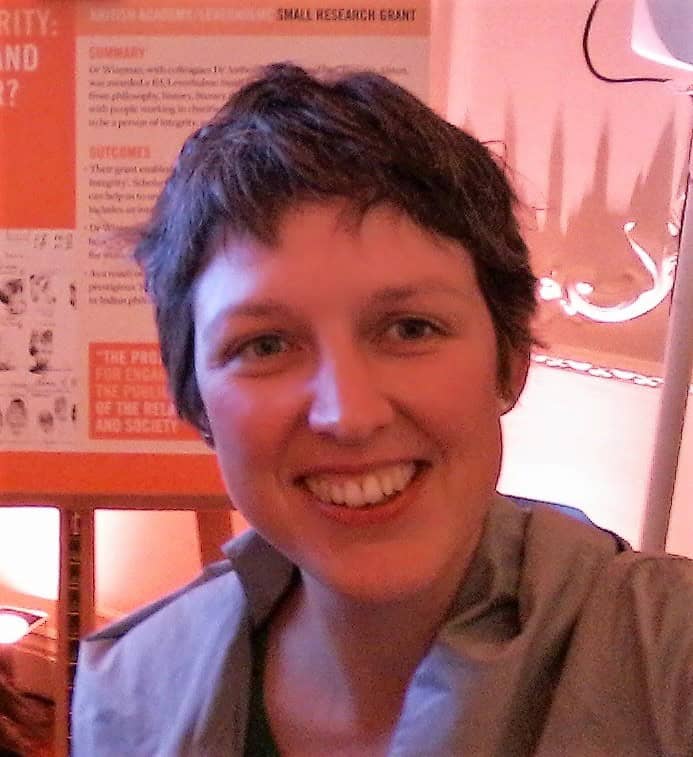
We’re joined now by Rachael Wiseman. She’s a reader in Philosophy at the University of Liverpool, and co-author of “Metaphysical Animals: How Four Women Brought Philosophy Back to Life.” Rachael, welcome to Philosophy Talk.
Rachael Wiseman
Hi Ray, Hi Josh. It’s great to be here.
Josh Landy
Yeah, it’s fantastic to have you. So Rachael, you’ve been working on Anscombe for some time now. What meaning has she had in your life?
Rachael Wiseman
Anscombe is just the most inspiring and exciting individual. I think she like she’s a woman philosopher who is a Catholic at a time when there’s a lot of anti Catholic sentiment. She’s raising seven children. She’s protesting against Truman being awarded an honorary degree Oxford University. She’s refusing to wear skirts and sort of turning up to lectures in trousers. She’s smoking cigars that she sort of picks up out the gutter. So she’s just this incredible character. She’s this force, you know, you couldn’t make up this person, and yet, on top of all of that, she just produced some of the most profound and exciting philosophy, I think, that I’ve ever read.
Ray Briggs
Yeah, she was such a colorful figure. And one of the things that she’s often remembered for is protesting against Harry Truman for dropping the atomic bomb on Hiroshima and Nagasaki. How did her ethical stance on the atomic bomb connect to her theory of intention?
Rachael Wiseman
Yeah, it’s interesting that you put it that way Ray because actually she says explicitly, this isn’t a protest about atomic bombs. It’s a protest about praising and flattering a mass murderer. So in the protest speech that she made that she then published as a pamphlet, she says, look, a lot of people defend Truman on the ground that what he did saved a lot of lives, so more people would have died if he hadn’t have dropped the bomb than if he had, and also on the grounds that although he gave the order, he wasn’t fully responsible, because he it’s not like he flew the plane or made the bombs, or, you know, pulled the trigger. So there’s this kind of dual idea, that he was responsible for saving lots of lives, and also he wasn’t fully responsible for dropping the bombs and that kind of muddled she thought the question of what the actual character of Truman’s Act was. So she says, Look, if somebody does something with the intention of killing some innocent people, then that makes them a murderer, full stop, and that’s the proper description of Truman’s act. So her worry about the worry in which responsibility was being attributed to Truman, both for saving lives that, you know, doing the thing he did somehow prevented from being lost, and mitigating his responsibility because he didn’t do it on her own. She thought that showed there was a real problem with the way that people were thinking about action.
Ray Briggs
One kind of defense of like Truman didn’t intentionally kill all those people that I know that she didn’t like, but I can imagine somebody making is, well, look, he knew the bomb was going to kill all those people, but that’s not why he did it. And in order to intend to do something, you have to know not just that it’s going to be a result of your action, but you have to want it as a result of your action. So what would Anscombe say to that?
Rachael Wiseman
Well, I mean, she would say, That’s just stupid, like you know that that’s what he wanted, because he dropped the bomb in order to get the Japanese to surrender? Well, just dropping a bomb wouldn’t get the Japanese to surrender. It was only dropping a bomb to kill a load of innocent people that would get them to surrender. So the death of the innocents wasn’t just a byproduct of what he did. It was an actual means to the end that he had the an end that he himself chose, and the fact that he didn’t have any kind of warm, fuzzy feelings about, you know, vaporized babies, as he did, it isn’t really relevant to the question of whether or not it’s something he wanted, because the deaths of the innocent were the means that he took to the end that he chose.
Josh Landy
You’re listening to Philosophy Talk today. We’re thinking about the life and thoughts of Elizabeth Anscombe with Rachael Wiseman from the University of Liverpool.
Ray Briggs
How do you know what other people are trying to do? Does it help to ask them, or are they just going to make up justifications? Do you even know what you’re trying to do?
Josh Landy
Confusion, delusion and intended action—along with your comments and questions, when Philosophy Talk continues.
OMD
Enola Gay Is mother proud of little boy today? Ah-ha, this kiss you give It’s never ever going to fade away.
Josh Landy
When Harry Truman ordered the Enola Gay to drop a bomb on Hiroshima, what did he really intend? I’m Josh Landy, and this is Philosophy Talk the program that questions everything…
Ray Briggs
…except your intelligence. I’m Ray Briggs, and we’re asking about the life and thought of Elizabeth Anscombe. Our guest is Rachael Wiseman from the University of Liverpool, author of “The Routledge Guide to Anscombe’s ‘Intention’.”
Josh Landy
it’s the latest episode in our wise women series, generously supported by a grant from the National Endowment for the Humanities. You can listen to all the episodes in this series at our website, philosophytalk.org/wisewomen. And while you’re there, you can also become a subscriber and act on your intentions in our library of more than 600 episodes.
Ray Briggs
Rachael Anscombe, I’ve read, didn’t think intention was one thing. She thought it was actually three different things. Can you explain that?
Rachael Wiseman
Yeah, that’s not quite what she says. So in her book intention, she begins by introducing her topic under three heads. So she says, look, there’s three different contexts in which the concept of intention occurs, or in which we might use the word intention. One is we talk about expressions of intention for the future. The second is we describe some actions as intentional, and the third is we ask for the intention with which something was done. So it looks like they’re three very different kinds of things. Like you say it looks like here we’ve got a state of mind, a property of some kinds of bodily movements, maybe some kind of rationalizing explanation. And Anscombe begins her book by saying, Look, if you’re unclear about the character of the concept of intention, then you’re going to start to think that really you’ve got three different things here. You’ve got a state of mind, a bodily action and a reason, and you’re going to start on a philosophical journey that looks for some connection between those three things. And that’s what she wants to stop. So she wants to say, Look, before you go down that route of saying, let’s try and make a connection between these two, three kinds of things. She wants to do. What I suppose is like a preliminary of saying, Well, what work does the concept of intention do? What’s its conceptual structure? And maybe, and this is what the book argues like once you’ve described the structure of the concept of intention, it’s no longer going to look like you’ve got three different things that you’ve got to somehow connect together in some sort of weird philosophical theory.
Josh Landy
Okay, so let’s think about that question, what work is the concept of intention doing, when one kind of work that it could be doing is helping us think about responsibility, right? I mean, how responsible was Truman for what happened, for example, is that a big part of what work the concept thing?
Rachael Wiseman
Yeah, it’s a massive thing for her to get clear about the concept of intention, because we need to be able to think about ethical cases. But she actually says in her really famous paper modern moral philosophy, which maybe we’ll talk about later, that we need to explore the concept of intention with ethics completely banished from her mind, our minds. So she thinks that basically, until you’ve got an account of action, you can’t do ethics. But if you approach the questions about action with ethics sort of at the forefront of your mind, you’re going to get muddled up, because ethics is so hard and action is so hard, and if you try and run them together, you’re going to get muddled. So intention, the book, which she writes about action, is not about ethics. So she doesn’t talk about issues to do with responsibility, right or wrong, justification, apart from, you know, reasons in the reasons for action sense in that book, although many of the cases she considers do have an ethical character like you said, the really famous one of the guy pumping the poison into the house is clearly a kind of ethical case with many parallels To sort of the Truman case. So the cases have an ethical character, but she doesn’t approach them in that book from a perspective of asking questions about responsibility. It’s like a prior investigation before we get to the ethics.
Ray Briggs
So if I’m not worried about responsibility, like, how else might I try to get a handle on intention? Or, like, what else is the concept doing for me?
Rachael Wiseman
Well, in your everyday life, of course, when you’re asking what somebody’s intentions are, when you’re asking what they’re doing, when you’re trying to find out what their intentions and acting are, that’s going to be part of your trying to make sense of them as a fellow human, trying to make predictions about the sorts of things that they’re going to do, trying to care about what they’re responsible for, and you know how you should feel towards them. But I guess the point that I was trying to make is the way to understand what it is that Anscombe. Doing in the book intention is to see it as an investigation into the structure of the concept of intention. And she thinks that in our day to day life, we’ve all got a really good grip on this, like we know how to do this stuff. So for example, if this woman barges past you on the tube and you’re like, Oh, my God, she pushed me out the way. And you say, Why did you do that? She says, Oh, I didn’t even see that. I’m really sorry. I was rushing. Then immediately, you know, right, that the description barging into this guy because I didn’t like his book on Proust isn’t a description under which she acted. It’s not something she did intentionally. So she’s interested in reminding, if you like philosophers of the deep structure in our use of the concept intention, that’s there already in our linguistic practice, and that philosophers kind of miss when they leap into this investigation where they’re like, Okay, we’ve got a mental state, we’ve got a bodily movement, we’ve got to somehow connect them. She’s sort of reminding you of all the structure that’s already there in your everyday use of the concept of intention, that for some reason, philosophers just kind of skip past when they start trying to do moral philosophy or philosophy of action.
Josh Landy
So here we are trying to figure out Anscombe intention in writing her book, intention, which is very appropriate, I think, one of the questions I had, I mean, it’s a fascinating book. It’s not always the clearest, but this is why we’re so grateful to have you here. But it’s super fascinating. And one of the things that struck me, I really like the way you put it. It’s we were very good at this in our daily lives, and we’re around intentions all the time, and we’re imagining, guessing at intentions all the time. One of the things that struck me is that she has a very nice line about how something like the story of my day is largely made up of movements that are either potentially actually voluntary. She sees intention, I think, correctly, almost everywhere. It feels like a picture in which human beings are agents. They are beings with with freedom to choose their actions. With that comes responsibility. Does that seem right to you? You know, she the world for Anscombe is a world of human beings who are in control of quite a lot of their actions and therefore potentially responsible for them.
Rachael Wiseman
Yeah, I think that’s exactly right. So she sees intention everywhere in human life, like you say. And I think there’s two parts of the book where that really comes out. One is that she describes in a lot of detail this specific linguistic tool that we have for finding out somebody’s intentions, which is the question why? And one of the things she does in the book is explores in like enormous detail with lots of fun and really interesting discussion the different contexts in which you might say, like, why did you do that? Why did you do that? And somebody says, Oh, I didn’t know I was doing it. Or, oh I did it in order to do this. Or, Oh, I did it because, you know, I just had this sudden feeling, God, I hate that man. You know, she explores all the different answers that might you might give to a why question, and she uses that to kind of bring out the great subtlety and nuance in our everyday understanding of intention. And the other thing she does, which again, picks up on this point that you picked out Josh about, she says, yeah, great number of descriptions of what happens in a person’s day to day life are descriptions of things that they do intentionally. So she’s really interested in the fact that our language, our ordinary language, contains hundreds of descriptions that have built into them, the structure of intention. So like telephoning, walking, commanding, pointing, pumping, poisoning, killing, like all of these descriptions are descriptions which evoke or use or have the structure of the concept of intention already built into them. So actually, our language is just rich with the concept of intention.
Josh Landy
She has a great list that includes kicking, dropping, crouching and marrying.
Rachael Wiseman
Yeah, the list is just hilarious because it’s so varied. But I think she sees this as telling us something really important about about humans and about what they’re interested in, like we’re so interested in what, not just in what’s happening, but in why it’s happening. And when it’s another human or an animal, you know, we’re just drawn to the question of, of why? What is this for? What are they going. After what’s the purpose. And actually, we have a vast number of descriptions already to hand in our language that we reach for in those kinds of contexts. And in fact, you know, as we all know, we’re so interested in intentional, intentional action, that we often use these descriptions of inanimate things, just because we can’t help ourselves, because we’re always sort of seeking out that pattern.
Ray Briggs
You’re listening to Philosophy Talk today. We’re asking about the life and thought of Elizabeth Anscombe with Rachael Wiseman from the University of Liverpool. So Rachael, you’ve been describing how one of the things that Anscombe is doing in her book, intention is to unpack like a kind of ordinary language concept of intention that just gets taught, captured in the way that people kind of talk every day. This kind of leads me to wonder, sort of what the role of philosophy is supposed to be. So one, one view that you could have is that, like, well, regular people are just kind of confused, and what philosophers are supposed to do is come in and regiment their concepts and like, explain to them stuff that they’re confused about, and maybe, like, help them see, like, whether their roommate was really intentionally leaving the dishes in the sink or whether it wasn’t on purpose. Another option is that people are getting along fine, and philosophers are just kind of coming in and muddling the waters. I assume that Anscombe thinks something in between, that how does philosophy just relate to what we’re doing when we’re muddling through life?
Rachael Wiseman
So she’s a Wittgensteinian, like she’s a student of Wittgenstein. She learned German so she could translate the philosophical investigation. So I think it’s useful to think of what she’s doing as a grammatical investigation in Wittgenstein sense, which means it’s an attempt to describe the structure of our language using life, a structure that we all inhabit whenever you know, because we’re human. So she has this lovely line at the beginning of intention, when she talks about us growing to the age of reason in a shared world. So when we grow to the age of reason in a shared world and acquire the capacity to use all these descriptions, that’s it, like we don’t need a philosopher to teach us how to use those descriptions, and a philosopher can’t kind of correct us in that kind of a way. So you’re right that there’s a sense in which there’s no place for philosophy in everyday life. But Anscombe is really attuned to the fact that certain philosophical ideas can kind of come to be adopted or come to shape everyday thinking about, particularly about abstract moral questions. So she sees, in the debate about Truman, a kind of model that she sort of sees as connected to a philosophical picture of intention and action, that, in a way, she kind of blames Descartes for, and in a way, she blames the Oxford philosophers for, where there’s a kind of philosophical program that gives people a Picture of intention and action, that makes them somehow forget what they already know when they sort of inhabit the world, and makes it look like, you know, your question at the beginning, well, you know, Oh, he didn’t really want to kill those people, even though he himself, you know, gave the order that they’d be killed. You know, the philosopher can kind of create a context in which that question looks pressing, and Anscombe wants to kind of give philosophers an understanding of the structure of the concept intention, so that they stop kind of going down that route and putting out these theories that are essentially, I mean, she uses the Word corrupting, but maybe you would just say like befuddling or confusing.
Josh Landy
Okay, I take that point, and I’m certainly on her side when it comes to Truman. But is she really always clearing up confusions as a part of her picture that I find actually befuddling myself rather than clarifying one of her key claims in the book, intention seems to be that, as she puts it, intention is never a performance in the mind. Now, most of us like to think that we form our intentions inside our head. But she says, No, that’s not right. And she even has this line, roughly speaking, a man intends to do what he does, so your actual behavior manifests your intention in some way,
Rachael Wiseman
Roughly speaking, Josh, roughly speaking.
Josh Landy
But I don’t even think roughly speaking a person intends to do what they do. I think oftentimes people fail to implement their intentions. They make a mistake. They get prevented. She also says, as a kind of corollary to this, anyone who sees me sitting in a chair writing will know what I’m up to. So you know, all you have to do is observe people acting, and we don’t. You know, we don’t need something about what’s inside their head. We know what their intention is. But I mean, is that true? She could be hypnotized in writing. She could be signing my death warrant. Why does she say this? This seems very surprising to me, this idea that there isn’t a thing that’s in my head when I intend to do something that is hard for you to know. I mean, I could tell you, but I could lie to you, for example. So what’s going on with that set of claims that seem really important in her philosophy of intention.
Rachael Wiseman
So on, the thing about you’re sitting in a room writing. So she has this example where she says, you know, suppose I’m sitting in a room writing. Anybody who’s grown to the age of reason in a shared world, when they come into that room is going to be able to, straight off, give some descriptions of what a person what I’m doing, which would also be descriptions of my intentional actions. And I think it’s kind of helpful here to think of like if you were a witness in a court case, so you know, you’re called to the witness stand and somebody says, you know, and what did you see the accused doing? And you’re going to be able to give a pretty accurate description, which is going to employ a lot of descriptions, which are also going to be descriptions of what that person was doing intentionally. So, you know, oh, he was lurking around behind the windows. He was creeping along under the headlight. He was, I don’t know, distracting the security guard, whatever it might be. Now, of course, you’re not going to be able to see straight off, what his further intentions. I mean, you might be able to have a pretty good guess if he’s, like, at a bank or something. But you know, in general, you’re not going to be able to see, you know, as you say, like, into his mind, like, why is he a bank robber? Like, is he trying to raise money for his ill grandmother, or, you know what’s going on inside him, if you like. So that’s why we have or that’s the context in which this question, why has its application. You know that you can ask somebody, I mean, in this case, it’s probably wise not to, because he could be dangerous. But in general, right? You can ask, why are you? Why are you writing? Oh, I’m, you know, I’m sending a letter to my aunt. Well, why are you sending a letter to my aunt? Oh, I want to find out she’s remembered me in the in her will. Well, why do you want to find that out? So we can use this question, why to, if you like, expand the descriptions of the actions to bring in wider and wider circumstances, that aren’t sort of visible to us there in the moment. So, of course, you can’t just look at somebody and see everything that unfolds through that action, but you you’re not going to be kind of, you know, oh, I’ve got no idea. Like, I can’t give a single description. Like, if somebody’s sitting in a chair or lying down or walking, these are all descriptions of their intentional actions.
Josh Landy
You’re listening to Philosophy Talk today. We’re thinking about Elizabeth Anscombe with Rachael Wiseman, co author of “Metaphysical Animals: How Four Women Brought Philosophy Back to Life.”
Ray Briggs
How do you make sure you have good intentions? Do the ends always justify the means would a better understanding of human nature help us make better choices?
Josh Landy
Finding purpose on purpose—plus commentary from Ian Shoales the Sixty-Second Philosopher, when Philosophy Talk continues.
Yael Naim
I’m a new soul, I came to this strange world.
Josh Landy
Intentional action is so hard—how many possible mistakes are there? I’m Josh Landy, and this is Philosophy Talk the program that questions everything…
Ray Briggs
…exxcept your intelligence. I’m Ray Briggs. Our guest is Rachel Wiseman from the University of Liverpool, and we’re exploring the life and thought of Elizabeth Anscombe. It’s part of our “Wise Women” series, generously supported by a grant from the National Endowment for the Humanities.
Josh Landy
So Rachael, before the break, we were talking about Anscombe, interesting and perhaps slightly controversial idea in her book, intention, that we can just read off somebody’s intention from their behavior. Anyone who sees me sitting in a chair writing will know what I’m up to. You’re suggesting that, well, I know that they’re writing and yeah, I have to ask them question. Why? Questions to get a bit deeper than that, why they’re writing, but I’m always going to basically know that they’re intending to put words on a page. Is that right? And does that explain why Anscombe says intention is never a performance in the mind. It’s not in the head at all.
Rachael Wiseman
I mean, I think this locution of like a performance in the mind, for her is deeply problematic, because she’s thinking about intention as related to the way we move around in the world and interact with each other and realize our goals and our choices in action. Now, it’s true, of course, that I can think something to myself, you know, oh, I’m gonna do such and such, and that I can have an intention for the future, which I never act upon. But I think what she wants us to move away from is the idea that whenever I do something intentionally, there’s some kind of inner performance that has us its result some kind of outer action. So by starting her or making the kind of main subject of her investigation, human action, intentional action. She helps us to see the way in which all the structure of intention is there, out there in the world, for us all to see and describe and observe, and that the kind of philosophical fetish for an inner performance is just that, like we don’t need to reach for the idea of some kind of inner performance. It’s true, of course, that I can mislead you. Know that I might try to hide from you what it is that I’m doing that I might, I mean. JL, Austin has this lovely example of somebody a thief who’s pretending to be a window cleaner by cleaning the windows. So he’s sort of doing the thing, you know, he’s cleaning the windows, but he’s sort of pretending to clean the windows, because he’s actually casing the joint. And so there’s all sorts of ways.
Josh Landy
My favorite example of hers is the ironic hug, right? Where somebody, somebody gives you a hug, but they actually hate you.
Rachael Wiseman
We do it all the time, right? But it’s something we have to learn to do, and it’s, in a way, a sort of development, a more sophisticated version application of the concept, if you like. So the basic idea is, look, here we all are. We’re in a shared world. You grow up, you learn all these descriptions of things that humans do, like telephoning, calling, signaling, paying, hiring, marrying, and learning those descriptions is both learning the word and learning how to do that thing and learning to recognize it like if you think about you know, when you’re bringing up your kids, you take them into a shop and you give them the money, and they hand it over at the till, And you’re teaching them what it is to pay for something, and once they get to be able to do it themselves, they can also recognize when somebody else is doing it and all the rest of that. So as you grow up, you’re brought into the space of intentional action, which is also the space in which you can follow orders, give orders, recognize what other people are doing, and ask what other people are doing. And then, of course, you get really smart, and you realize, oh, hang on a second, I can, like, hide what I’m doing in various ways, but I think Anscombe thinks there are quite a lot of limits on that, because a condition on what you’re doing being an intentional action is that ultimately, it’s intelligible within this structure of a shared life. And so although you can kind of hide your intentions to a certain degree that there are limits on the amount of privacy that’s possible.
Ray Briggs
So Rachael, we’ve talked a lot about Anscombe on intention. We’ve also talked about Anscombe speaking up against Truman’s being awarded an honorary degree because of his bombing of Hiroshima. What’s an event happening today that her philosophy could shed light on?
Rachael Wiseman
I think the thing that I’m really drawn to in Anscombe philosophy, which is also in Wittgenstein’s philosophy, is this insistence on animality, on sociability, and on the requirement of mutual intelligibility, and on this kind of really close investigation into the ways in which our animality, and in particular, like what we need to flourish, what counts as our lives going well, kind of constrains our possibilities and our morals and our politics and our language and everything else. And I feel like. Maybe we’re at a kind of time now where there’s this great desire to not think of ourselves as you know, these vulnerable little animals who are relying on each other and sort of trying to gather to create a meaningful life that we can all understand, but that somehow Our goal should be to sort of transcend our embodiment, make ourselves more and more independent, break free of the constraints that being embodied seems to bring on us. And I think Anscombe work is a really good reminder that, in a way, we should start by thinking about our lives together as the kinds of animals or creatures that we are.
Ray Briggs
So on the one hand, I like this as a general approach. On the other hand, I’m worried about some of the applications that Anscombe made of it. So particularly, she had this very conservative sexual ethics where she was opposed to like, homosexuality, abortion, contraception. How do we accept the good parts of her theory without going down that road?
Rachael Wiseman
Yeah, I mean, I think that’s a really good and difficult question for people who work on Anscombe I mean, you’re right that her sort of Applied Ethics, if you like, her practical ethics, particularly her sexual ethics, are basically conservative Catholic. So she kind of toes the conservative Catholic line on all of the issues that you might hope she wouldn’t, but she definitely does. And I think there’s all sorts of ways in which you can extract the sort of picture that I’m talking about out of that particular practical ethics. So for example, her views about contraception are grounded or stem out of a view about the nature or the character of a sexual act which in which he says, you know, it’s an essentially generative act. So a sexual act is only a good action if it has this characteristic of being essentially generative. And she compares it to like, you know, an act of eating. The description eating is a description of an essentially nutritive act. So it’s a act that is done for the getting of nutrition. And so if somebody is just stuffing stuff into their mouth that isn’t nutritious, then this is somehow disordered because it’s not doing the thing that it’s meant to do. So she compares the sexual acts that don’t have this generative character to eating acts that don’t have this nutritive character. Now, of course, there’s all kinds of ways in which you might push against that kind of comparison, and in which you might, you know, take issue with the kind of theological framework within which we understand sexual acts as having this essentially generative character. So I think there’s plenty of room for, you know, rejecting some of the sort of specific, practical consequences that she draws. But I do think that it’s absolutely core to the structure of her philosophy that there is a kind of absolutism, moral absolutism in there, so that this idea that there are certain kinds of actions that are prohibited.
Josh Landy
Is there some other aspect of Anscombe’s philosophy that isn’t getting enough air time these days? We’ve talked about intention, we’ve talked about some of her more controversial religious positions, we’ve talked about the ironic hug and ethics. Can you name one other thing that you think you know we should, we should get on the table before we have to say goodbye.
Rachael Wiseman
There’s so much of Anscombe philosophy that hasn’t been read or talked about. I think her writings on promising and justice are absolutely brilliant. Her writings on causality have had some influence, but not as as much as they they ought to have on justice.
Josh Landy
She says it may be an injury not to be believed, which seems incredibly ahead of her time.
Rachael Wiseman
Yeah, I just think there’s so much in Anscombe and almost everything she writes, as you’ll know from having, you know, looked at intention here has just layers and layers and layers of interest and humor and depth that I. I don’t know. I just think wherever you start, you’re gonna find gold.
Josh Landy
That’s beautifully put, Rachael and you know, we intended to have a great conversation today, and I think we pulled it off.
Rachael Wiseman
It’s been lovely to be here.
Josh Landy
Our guest has been Rachel Wiseman. She’s reader in Philosophy at the University of Liverpool, and co author of metaphysical animals. How four women brought philosophy back to life. So Ray, what are you thinking now?
Ray Briggs
So I want to highlight one other idea of Anscombe that we didn’t get to in the show, which is that she has this great criticism of Descartes’ Cogito. I think, therefore I am so one of the things that Descartes tries to prove is that the body and the mind are different, because he can imagine thinking without a body, but she’s like, if that argument worked, he could also prove that he is not Descartes, because he can, like, imagine, oh, I am not Descartes. So I thought that was a really cool criticism.
Josh Landy
Who’s the i Who thinks it’s really cool, criticism, just kidding. No, I love that, and we’re gonna put links to that and to everything you’ve mentioned today on our website, philosophytalk.org where you can also become a subscriber and question everything in our library of more than 600 episodes.
Ray Briggs
And don’t forget, you can also listen to all the episodes in our wise women series at Philosophy talk.org/wisewomen.
Josh Landy
Now, does he really intend to talk that fast? It’s Ian Shoales the Sixty-Second Philosopher.
Ian Shoales
Ian Shoales… Man, that G.E.M. Anscombe was quite a gal. She came into her own in the depths of a. 20th Century moral panic around Chrisitanity in the wake of Darwin, Freud, and Marx, one world war, and another clearly coming for those with eyes. She converted to Catholicism in her teens, along with her not yet husband, with whom she would have seven children, when she wasn’t bringing C.S. Lewis to tears (allegedly), or translating her guy Wittgenstein into English. They were best friends! He called her “old man,” which I guess was endearing? Enabling all this was her big brain swooshing through analytical philosophy all of her adult life, much of it analytical Thomism, which suited her to a tee. The Thom was Thomas Aquinas, of course, once beloved by the Catholic Church, then cancel cultured kind of, over centuries, but in the later 19th Century resurrected as a way for the church to engage with the scary modern world, by hitting reboot on all the ways the Church became a world beater in the first place. Her Catholic-infused philosophizing at Cambridge enabled her to question the premises of western moral thought, and at the same time, allow those premises to guide her, not because they are philosophically sound, necessarily, but because they came from a higher authority. I’m no genius, but it seems like she figured out a way to discuss virtuous behavior and actions without involving concepts like guilt, innocence, or even simple culpability. She took a Thomist view of morality that’s forward facing, as the kids say. If you are a virtuous person you will act virtuously. Duh. Hello. She was against that view of morality which she dubbed consequentiality. She gave us that word! That is, roughly, even if you killed one to save five, you still killed somebody. This was also a a dig at the greatest good for the greatest number school. She wrote a lot, some of it still being uncovered and published today, about all kinds of things, including an essay on whether the word “I” refers to anything or not, an essay questioning C.S Lewis regarding a claim he made about Naturalism (which they both renounced) which was, I think, that Naturalism didn’t believe in miracles, but thinking itself is a miracle, and they believe in that, therefore, again, I think they both agreed, but she criticized the terms on which he premisized. I think. It was all very analytical She was a very popular teacher, dynamic, eccentric, and terrifyingly smart. She wore a monocle, which she would let drop upon her ample bosom, to emphasize a point, She wore trousers except when she was pregnant, chainsmoking cigarets, then switching to cigars and pipes. She was quite foul mouthed though never blasphemous. She became famous when she protested Harry Truman’s okay for bombing Hiroshima and Nagasaki. She later became famous in Catholic circles, for her opposition to abortion, and to contraception itself. She believed sex was sacred in that it is the means by which babies are made, and should not be used for other purposes, like killing time on a lazy summer afternoon, say, or pleasure. She wrote that the “perversion of the sex act in marriage is, in this one way, like writing a forged check for a good cause.” That is so Jesuitical! I was surprised to learn that she was quite famous for this. There were, and maybe still are Abstinence Centers named for her, Anscombe Abstinence Centers. Sounds like something you’d find at a mini-mall, sandwiched between a donut shop and a certified public accountant, though what girls would do at an abstinence center is a mystery. Jigsaw puzzles, I guess, maybe whist or Old Maid marathons. Teen dances would be out probably. When I was in college, our student union was right next to the Newman Center, for Catholic students to gather, but I never saw anybody go in. Not to say that abstinence wasn’t rampant back in 1969 on my small campus in Central Minnesota, but I would say that as far as sex being a sacred activity best saved for marital procreation and conception, well, Miss Anscombe didn’t leave this vale of tears until 2001, but even she must have clearly seen, large Catholic families, large Mormon families, large Duggar family notwithstanding, that that ship has sailed. Not that sex is always fun, necessarily, but at least we’re not always stuck with unwanted offspring at the end of it. You feel me? I gotta go.
Josh Landy
Philosophy Talk is a presentation of KALW San Francisco Bay Area and the trustees of Leland Stanford Junior University, copyright 2025.
Ray Briggs
Our executive producer is James Kass. The senior producer is Devon Strolovitch, Laura Maguire is our Director of Research.
Josh Landy
Thanks also to Pedro Jimenez, Merle Kessler, and Angela Johnston.
Ray Briggs
Support for Philosophy Talk comes from various groups at Stanford University and from subscribers to our online community of thinkers.
Josh Landy
And from the members of KALW local public radio San Francisco, where our program originates. Support for this episode, and all the episodes in our wise women series comes from the National Endowment for the Humanities.
Ray Briggs
The views expressed (or mis-expressed) on this program do not necessarily represent the opinions of Stanford University or of our other funders.
Josh Landy
Not even when they’re true and reasonable. The conversation continues on our website, philosophytalk.org where you can become a subscriber and question everything in our library of more than 600 episodes. I’m Josh Landy.
Ray Briggs
And I’m Ray Briggs. Thank you for listening
Josh Landy
And thank you for thinking.
Guest
Related Blogs
-
January 9, 2025
Related Resources
- G.E.M. Anscombe (1957), Intention.
- Roger Teichmann (2011),The Philosophy of Elizabeth Anscombe.
-
Clare Mac Cumhaill and Rachael Wiseman (2022), Metaphysical Animals: How Four Women Brought Philosophy Back to Life.
Get Philosophy Talk
