Mary Midgley
November 29, 2026
First Aired: May 18, 2025
Listen


Mary Midgley became one of the best known public intellectuals in the UK, and was one of the first philosophers to talk about climate change. Though she didn’t publish her first book, Beast and Man, until she was 59, she wrote many influential works on science, ethics, and animal rights. So, why did Midgley argue that the climate crisis was ultimately a conceptual problem? What was her criticism of scientism, the view that only science can provide knowledge about the world around us? And why did she think the work of the philosopher is a bit like that of the plumber? Josh and Ray explore her life and thought with Clare Mac Cumhaill from Durham University, co-author of Metaphysical Animals: How Four Women Brought Philosophy Back to Life.
Part of our Wise Women series, generously supported by a grant from the National Endowment for the Humanities.
- Animals
- |
- Climate Change
- |
- eco-feminism
- |
- Environment
- |
- Nature
- |
- Women
Ray Briggs
Can science explain everything?
Josh Landy
Is there such a thing as human nature?
Ray Briggs
Aren’t we more than just the sum of our genes?
Josh Landy
Welcome to Philosophy Talk the program that questions everything…
Ray Briggs
…except your intelligence. I’m Ray Briggs.
Josh Landy
And I’m Josh Landy. We’re coming to you via the studios of KALW San Francisco Bay Area.
Ray Briggs
Continuing conversations that begin at philosophers corner on the Stanford campus, where Josh teaches philosophy.
Josh Landy
And the University of Chicago, where Ray teaches philosophy.
Ray Briggs
Today, it’s the next episode in our “Wise Women” series, generously supported by a grant from the National Endowment for the Humanities. We’re exploring the life and thought of Mary Midgley.
Josh Landy
One of the Oxford quartet, along with Elizabeth Anscombe, Iris Murdoch and Philippa Foot.
Ray Briggs
Yeah, we got shows on all four of them in our series. Midgley was also a big public figure in the UK.
Josh Landy
Right, I remember her being on the radio when I was a kid.
Ray Briggs
Yeah. She talked about the value of the humanities, about environmentalism, about science.
Josh Landy
She loved science, but she was very critical of a thing called scientism, right. The idea that science can explain everything.
Ray Briggs
Wait Josh, she thought there were things that science can’t explain? I don’t want to be dismissive, but that sounds a little bit woo-woo.
Josh Landy
Oh I don’t think so. I mean, she wasn’t some kind of mystic. She just thought scientists should stick to, you know, science and and stay out of domains they don’t belong, like ethics or metaphysics.
Ray Briggs
Metaphysics—you mean the study of how the world really is? That’s exactly what science is supposed to tell us. Physics breaks the world down to into its most basic parts. You can’t get much more real than that.
Josh Landy
No, no, no. Physics breaks the world down into its smallest physical parts, but it can’t tell us how living things work, and it certainly can’t tell us how our minds work.
Ray Briggs
Fine, maybe physics can’t tell us that, but that’s why we have other sciences. You’ve got biology, psychology, neurochemistry. Poke around long enough and you’ll find a scientific explanation for everything.
Josh Landy
That’s a horrifying thought. Ray. And I don’t think Midgley would buy it either. I think she’d say, it doesn’t matter how much data you compile, there’s always going to be bigger questions that science just can’t answer. Yeah, like, what? We’ll take one of midgley’s favorite examples. How should we think about non human creatures?
Ray Briggs
I don’t see how that’s a counter example to anything I’ve been saying. Science tells us that, hey, cheetahs need a lot of space to roam, but sloths, they’re perfectly happy staying in one place. It gives us a lot of information about animals and about how we should treat them.
Josh Landy
I think Midgley would object to your whole way of framing the question how we should treat them. It’s not a matter of how we should treat animals. We are animals. Midgery thinks that we human beings, have invented this spurious category called animals, as though they’re one big lump and we’re over to the other side being all special.
Ray Briggs
Well, aren’t we special in some ways? I mean, aren’t we at least special in thinking that we’re special?
Josh Landy
Not even that. That’s actually one of midgley’s coolest points. She says that when a bird is singing, it’s really saying, “Hurrah, hurrah. It’s me. It’s mine. I’ve got it. I am the greatest.”
Ray Briggs
Okay, I love that, but I still don’t understand how that tells us anything about the limits of science. It seems like science tells us what birds are thinking, and science tells us that human beings are animals too. Midlgey thought it tells us even more. She thought science tells us that the Earth is alive and that we have to take care of the environment.
Josh Landy
That’s true. She was a big fan of the Gaia hypothesis, the thought that everything on this planet is is part of one giant living system.
Ray Briggs
But I don’t get it. If even the Gaia hypothesis is part of science, what is left that science can’t explain?
Josh Landy
aThat’s really good question. Ray, a better guest is going to have things to say about it. It’s Claire MacCumhaill from Durham University, co-author of “Metaphysical Animals, a really great book about the Oxford quartet.
Ray Briggs
But first we sent our roving philosophical reporter, Sarah Lai Stirland, to investigate midgley’s ideas about animals in the Gaia hypothesis. She files this report.
Sarah Lai Stirland
Philosophers often think humans are at the pinnacle of life on Earth, but Mary Midgley was more concerned about whether there be any life left to debate about. She said we should pay respect to Gaia, not as some new age goddess, but as shorthand for the incredibly complex systems we depend on, but that we treat like rubbish. In 2014 she told biologist Tom Wakeford…
Mary Midgley
Our relation to the Earth is as close as our relation to the people around us on whom we most depend. We naturally love it. It has made us what we are. We are part of it. We’re grateful to it, and we’d respect it.
Sarah Lai Stirland
The name is based on a myth, but the Gaia hypothesis has actually been studied a lot by scientists, James Lovelock and Lynn Margulis first published a paper on it in the early 1970s they observed that ecosystems, the ocean and the atmosphere, interact, and they form a self regulated. Planet, the system maintained conditions that were conducive to life for 3.2 billion years. So by the 1970s this balance was being disrupted. Mary Midgley was born in 1919 in London. She spent her early years in the countryside of Middlesex. She studied philosophy Oxford, and later taught at Newcastle in 1950 she married another philosopher, Jeff Midgley, and they had three sons. It wasn’t until the 80s, though, that Midgley started writing about the implications of the Gaia hypothesis. It grew out of her interest in zoology, as she told BBC broadcaster Sue Lawley in 2005.
Mary Midgley
What really made it all come together was that I got passionately interested in animal behavior in the accounts given by people like Jane Goodall and Conrad Lorenz and others of how animals actually behave.
Sarah Lai Stirland
Reading about animal behavior made her challenge to the 17th century philosophers who claimed our intellect set us apart from other species. It led her to establish her lifelong thesis about our animal nature and its implications. In her first book, “Beast and Man.”
Ellie Robson
She thinks that we should start doing moral philosophy by thinking about what human nature is like, what kind of animal is a human.
Sarah Lai Stirland
Ellie Robson is an ethics lecturer at King’s College in London. She says, Midgley argued that humans are not just thinking machines. We’re shaped by both our biology and the world around us.
Ellie Robson
We’re lots of different kinds of things. We’re social, emotional, rational, playful, imaginative, loads of these things we share with non human animals.
Sarah Lai Stirland
So what does it really mean to live by Midgley’s credo in the 21st century? Philosophy in the Wild is a new project that invites the public to explore this. Our idea
Mara-Daria Cojocaru
Our idea is to improve philosophy and come up with inspiring and hurtful visions of what it could be for humans and other animals to live together in a better way.
Sarah Lai Stirland
That’s Mara-Daria Cojocaru, a philosopher-poet in London. She’s the project director for Philosophy in the Wild. The project’s goal is to convene local groups of philosophers, scientists, artists, kids and other species of animals around the globe to explore how they can live in caring communities in april 2025 for example, a writer and a local artist took sixth graders to Norway’s remote Vega islands. There, they learned how humans and wild EIder ducks cooperate as part of a 400 year old tradition, islanders build shelters for the ducks during nesting season to protect them from predators after the ducklings leave, humans collect variable down from the nest a duvet worth can sell for 1000s of dollars.
Mara-Daria Cojocaru
Through evolution, a relation has evolved between humans and other animals where both gain from the elation so it’s not exploitative.
Sarah Lai Stirland
Other communities from Brazil to Bangalore will convene to discuss their relationships with dolphins, bats, wolves, seals, bison and feral dogs. Each animal, human team is tasked with composing a “multi-species poem.”
Mara-Daria Cojocaru
A poem that includes also visual or scent elements.
Sarah Lai Stirland
Cojocaru believes smell connects us to our animal nature. So each site has kits with tins and glycerin to extract local scents.
Mara-Daria Cojocaru
It’s a playful and creative approach to language and human animal relations.
Sarah Lai Stirland
Kids and the kids inside of us are key participants.
Mara-Daria Cojocaru
I think the best review I once got from a workshop on multi species poetry for children was better than the Halloween party last week. What do you want more?
Sarah Lai Stirland
Mary Midgley said philosophers should provide tools to help people unclog modeled thinking. Poetry envisions new possibilities.
Mary Midgley
When people get stuck by being obsessed with a single way of looking at things, stand dark and see well what the neighbors of this are.
Sarah Lai Stirland
Gor Philosophy Talk. I’m Sarah Lai Stirland.
Josh Landy
Thanks for that super interesting report, Sarah. I’m Josh Landy, with me is my fellow philosopher Ray Briggs, and today we’re asking about the life and thoughts of Mary Midgley.
Ray Briggs
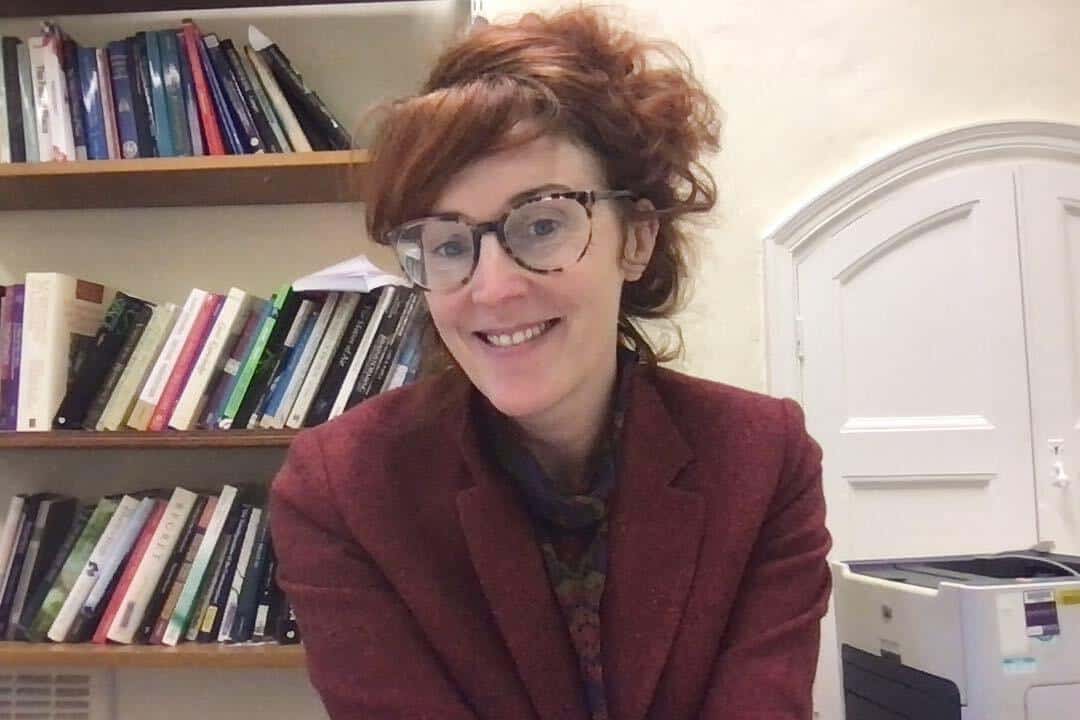
We’re joined now by Claire MacCumhaill She’s professor of philosophy at Durham University in the UK and co author of “Metaphysical Animals: How Four Women Brought Philosophy Back to Life.” Clare, welcome to Philosophy Talk.
Clare MacCumhaill
Thank you so much.
Josh Landy
So Claire, you actually knew Midgley, and you visited her in a nursing home towards the end of her life. Can you tell us about the kinds of conversations you had with her?
Clare MacCumhaill
Yeah, I used to visit her with my friend, my good friend and co author, Rachel Wiseman, who you had on the show a little while back. And we used to go to Mary and talk to her about her talk. I’m at Oxford during World War Two, so she was a student there, and she used to sit in this amazing Gray, puffy, very supportive chair, because she was 95 when we first started going to talk to her, and she just tell us about the figures that taught her, and they were huge names like Archie Collingwood, H price, and she just lean over and take a book off the bookshelf and just, you know, talk about these historical figures as if they were in the room. And there were biscuits, always biscuits.
Ray Briggs
Yeah, she sounds very charming, and we know that she managed to reach a wide audience with her philosophy, including Josh when he was a kid listening to the radio. What was she most known for in the public imagination?
Clare MacCumhaill
Well, she’s most quickly, but maybe a bit too easily associated with a critique of Richard Dawkins’s idea of The Selfish Gene. As you probably know, Dawkins published his book on The Selfish Gene in 1976 I think it was, and that’s a biology book, but Midge was really, really worried that that, in fact, is telling us, giving us a picture of the kinds of beings that we are, that we’re selfish, and she’s writing this critique, whatever, developing all these arguments against Dawkins in the 1980s so this is a period when there’s a Conservative government. So you know, Margaret Thatcher is in government, and she’s just worried that this idea is going to seep into public consciousness and maybe start influencing kind of behavioral economics and so on.
Josh Landy
Because the idea is that if we’re naturally selfish, then it’s okay to be selfish. Is that the thought?
Clare MacCumhaill
Exactly, but apart from that, she’s also worried about, you know, Dawkins is a scientist, and he’s using this word really carefully in the way that a scientist does with precision, and that gives it a kind of authority. And she’s worried about that. And she’s also saying, wait and stop the whole notion of selfishness. It only makes sense when you look at us in the context of our kind of sociality, the fact that we’re social creatures. We do things together, you know, we share we look after each other in infancy and old age and so on. And it’s only when someone is not doing that that we call them selfish. So it not only kind of distorts our understanding of ourselves. It just gets us completely wrong from the start.
Ray Briggs
So this is very interesting to me, because, like, on the one hand, like Dawkins actually isn’t claiming in that book that we are selfish. He’s claiming that our genes are selfish. So like, I think that there’s a bit of room to criticize. On the other hand, given the way that UK society is gone and kind of Dawkins has gone like, do you think that she had a point about the rhetoric of selfishness?
Clare MacCumhaill
Yeah, it’s very much about the rhetoric. So one of Midgley’s big sort of claims is that we’re these kind of creatures who create images and world myths and narratives, and we’re those kinds of creatures, and we are guided and we orientate ourselves in terms of these myths. And so if a myth at a particular historical moment is harmful, that’s a problem. So the idea of The Selfish Gene in itself might have been okay at another historical moment like so if Dawkins was a Hobbes type figure, and he was trying to kind of overthrow feudal structures or something, it might have been good in that historical context. But in the 1980s in Britain, she thought this is actually a really, potentially disastrous idea, and that’s what she was objecting to. And it sort of ties into what Josh was saying at the start about scientism.
Ray Briggs
Say more like, what’s, what’s the connection there?
Clare MacCumhaill
Well, but it’s, again, this idea that Dawkins is a scientist, and he’s giving us this way of picturing ourselves at a very rudimentary, sort of basic level that is simple, like he’s saying, our primary motivation is, you know, to compete and to win. And that kind of simplicity is really easy to, you know, start thinking, you can apply a picture like that, just really widely. So it’s the combination of the apparent scientific precision with the simplicity, which is, of course, a virtue in science, but it’s a bit of a slippery slope, and you might start thinking that this very idea, then just can start infiltrating other explanatory domains and start doing kind of work there where it’s really not needed and it’s really not at home.
Josh Landy
You’re listening to Philosophy Talk today. We’re discussing the life and thought of Mary Midgley with Claire MacCumhaill from Durham University.
Ray Briggs
Is it okay to keep animals in zoos? Should we all be vegetarians? Can science answer these questions?
Josh Landy
Human rights, animal rights, and rights for the whole planet—along with your comments and questions, when Philosophy Talk continues
The Kinks
I am an apeman.
Josh Landy
Are we human beings as special as we like to think we are, or are we all just ape men? I’m Josh Landy, and this is Philosophy Talk the program that questions everything.
Ray Briggs
…except your intelligence. I’m Ray Briggs, and we’re exploring the life and thought of Mary Midgley. Our guest is Claire McCool from Durham University, co author of “Metaphysical Animals.”
Josh Landy
It’s the latest episode in our “Wise Women” series, generously supported by a grant from the National Endowment for the Humanities, you can listen to all the episodes in the series at our website, philosophytalk.org/wisewomen. And while you’re there, you can also become a subscriber and go wild in our library of more than 600 episodes.
Ray Briggs
So Clare, Midgley wrote about a wide range of topics, science, ethics, animal rights. Is there one theme that unites all of her ideas?
Clare MacCumhaill
There is, and it’s actually the first line of her first published book, which she wrote when she was what was published when she was 57 so the book is called beast and man. And the first line, famous first line, is, we are not just like animals. We are animals. And she says herself, like that is the starting point from which my, all of my philosophy springs. So, yeah, so that is the line, the continuous thread that goes through everything. And there’s 1818, or 19 books, depending on how you count.
Josh Landy
So what follows from that?
Clare MacCumhaill
Well, a lot follows from that. Okay. So you can start with the, you know, the very beginning, which is, she is not a Cartesian philosopher. So she’s not a philosopher who thinks that there’s a distinction between mind and matter. And you know, if you think there’s that distinction, there’s a real problem about how they fit together again. But she says, No, we’re actually animals. You need to kind of go back before Descartes to Aristotle into the ancients were animals where we’re living things. So that that’s the start. But, of course, it’s only the start. I mean, she does so much with that. So she, she once said to me, and I love this image, she said that for her, her Neil Armstrong was Jane Goodall the primatologist. I think when she said that, the thought there is that like what the ethologist does, or what the, you know, what Jane Goodall did was as transformative to our self understanding as seeing the Earth from space, you know. So the work of the ethologist is a really, kind of crucial feature for work. And her method in that book and beast in man is to draw on the work of the ethologist to do moral philosophy. And that’s, I mean, it’s amazing. There’s nothing like it in the late 70s or even later.
Ray Briggs
Okay, so if I’m thinking about the kind of pushback that this idea would receive, like I would think that somebody might say, Well, look, there’s one question about how human beings, in fact, behave, but there’s another question about what we should do, and these just aren’t that closely related. Why did Midgley think that they were closely related?
Clare MacCumhaill
Yeah, that’s a really good point. I mean, I actually have a colleague who’s a moral philosopher and a friend, and he just thinks our animality is completely irrelevant to moral philosophy. But Mary Midgley has a particular understanding of what humans are like and all animals, in fact, we are creatures that have certain kind of motivational tendencies. And those motivational tendencies are a bit like vectors. So you might think of them in terms of like the motivation to seek attachment or to dominate or to play or to create or to ask questions, for example. And for her, human nature is comprised of these motivational tendencies. They actually form a knot for her, and it’s in the context of this idea that she thinks you can begin to do moral philosophy, because for her, if I can go on a tiny bit, for her, what we value is connected to what we need as animals, and then we’re motivated to go after what we need. So you start with our animality. Then you get an explanation, as it were, of what we value, because we value what you need. And then we go after we’re motivated to go after what we need. So the moral philosophy comes out then of an account of human nature, which is an account of us as having this sort of motivational, kind of structural, not at the harsh of our being?
Josh Landy
Well, I can see how the how science gives us a better characterization of what we’re actually like, right? We’re animals, just like any other kind of animal. Our you know, our physical being gives us certain needs and motivations. I can totally see that, but I don’t understand how you get from there to morality, because I could say, well, you know, my animal nature drives me to really like chocolate biscuits. I think mentally would have approved of that example. But, you know, maybe those chocolate biscuits aren’t that good for me, and I need something else over and above my, you know, my, my current motivations, and of course, there are worse examples, right? Maybe my, maybe part of your part of my animal being drives me to satisfy my desires at the expense of somebody else, or something like that. So don’t we need something else, over and above this scientific description of the kind of creatures that we are in order to get us morality?
Clare MacCumhaill
Sure, well, the idea is not just like we are animals in some kind of vacuum, right? We are social animals, and we are culture creating animals. So we in fact, develop cultural institutions and practices like religious practice, practices that help us kind of keep our motivational set in the in a kind of order. System that serves us well. Okay, so for example, we might have what some philosophers sometimes call the stopping models, like, Thou shalt not, you ought not. So we develop these systems that kind of help us shape our ways of going on, in ways that, you know, in beneficial ways. So it’s not just that we’ve got a kind of specimen type biological creature that does have these kind of innate tendencies. We have to think of ourselves as these culture building animals, and with that comes in the kind of constraints and morality.
Ray Briggs
Clare, you mentioned our religious tendencies, and Midgley had quite a lot to say about those like, what was her take on religion?
Clare MacCumhaill
So going back to these motivation, these motivational tendencies, we have a need, a spiritual need, to understand actually, and philosophy is part of that. Okay, so the title of the book I wrote with Rachel, metaphysical animals. We are. We have this. We’re motivated to to seek comprehension, and, in a way, some kind of unity to our experience, or at least intelligibility, and religion is part of that, in fact. So religion satisfies that need. It also can not, not to give a reductive account of religion, but or a functional account, but it can also satisfy, or at least serve, our needs for community, you know, forms of communal experience. It also can ritualize certain kind of practices where we need to express remorse or seek forgiveness, depending, you know, but so depending on what, what is needed. The The idea is that for her, religion is a is a natural human produced kind of phenomenon that serves our needs. But she, she doesn’t have a She has great respect for for religion. I mean, religion is a the great world. Religions are like a kind of storehouse of of language, and like rich moral terms that we can use to make intelligible our experiences. So she’s, she’s agnostic. In fact, herself, I would say, and her father was, was a vicar and very influential figure on her in fact.
Josh Landy
you’e listening to Philosophy Talk today. We’re asking about the life and thought of Mary Midgley with Claire MacCumhaill from Durham University. So, Clare, you were just talking about Midgley’s attitude towards religion and metaphysics more broadly. And this is one of the things I love the most about Midgely’s thinking that she, as you say, she thinks we’re metaphysical animals. She doesn’t think that what philosophers do is this weird, sort of frivolous, decadent thing that just, you know, gets invented when people are sort of bored and they need to, you know, set themselves logic puzzles. She thinks we’re actually all human beings have this, I don’t know, innate, instinctive, natural need, right, desire, but also even need to think about what is real and what is good. It’s so philosophy is sort of continuous with what we do in everyday life. And she has that lovely image that philosophy is like Plumbing. Can you say a little bit about that brilliant metaphor, that philosophy is like Plumbing.
Clare MacCumhaill
Yes, you’re absolutely right. Philosophy, for her, is a basic human need, and it’s going on all the time, and we’re all philosophers. So there’s, you know, all of all of us are philosophizing. We’re deciding what to do. But then there’s the professional philosophers as well, I guess, plumbers. Yeah, there’s the pay plumbers. So the question is, you know what they what should they be doing? So first of all, the thought that philosophy is a bit like plumbing that requires a certain view of concepts. Okay? So she doesn’t think a concept is a bit like a massive sieve that goes around and kind of scoops up everything that looks vaguely sort of similar and might fall under the same. It’s not like when she’s scooping up red things. She’s scooping up like London busses and apples and so on. She thinks no concepts have a structure, and it’s not a simple structure. Concepts are very, very complex, and our conceptual systems are complex. So with the plumbing analogy, she’s trying to say, look, think about plumbing. Think about a building. You know, I’m in Durham. It’s a medieval city. The plumbing that was probably put in underneath the cathedral is no doubt, very faulty, but it’s been repaired and added to over the years. It’s now an absolute hodge podge of additions, some of them working on, some of them not working. Our concepts are like that. There are these structures, you know, that were created at certain kind of periods of history, and have all of these added bits and bits that don’t kind of work. And what the philosopher needs to do is sometimes our our concepts lead to stagnation and thought like there can be a blockage in our thought, or there can be a leak, and the philosopher needs to go in see where there’s a blockage using the skills of analysis.
Ray Briggs
Yeah, I want to ask about analysis, because midgley’s methodology seems really at odds with what a lot of the philosophers like around her and around me are doing, where you’ve got a concept into to understand what the concept is, you give sort of necessary and sufficient conditions for falling under that concept, like, what is it to count as red? So I take it that like this. Doesn’t take into account a bunch of the structure. Is there a methodological upshot to thinking of concepts as these structured, old legacy things?
Clare MacCumhaill
Yeah, there is a methodological Upshot. So she’s a kind of Wittgensteinian, I guess. So Wittgenstein famously said, Look, don’t think and what you need to do as a philosopher is, if you’re kind of doing it in the midget mode, is you need to kind of look at where there are, if you like, conceptual dysfunctions, or where there is blockages and thought in at the historical moment that you’re in, where you when you find yourself, and we can think of lots now, right, where we have problems with our concepts. We’ve got troubles and concepts, you know, we’ve got whole swathes of people who can’t make their experience intelligible in various ways because of, you know, we’ve got concepts that actually need more structure. So, so the method is, is not to try and create a list of necessary and sufficient conditions, sort of on your own, in your room, in the armchair. You need to look at the world and see where there are actually conceptual problems, where there are blockages. And then you need to, obviously be able to work out what those are. So there you kind of need a little bit the notion of analysis is more like the kind of forensic notion. You need to kind of dig deep and see where the blockage is.
Josh Landy
Which gets us back to plumbing, right? I mean, that, in a sense, you know, all of us have plumbing. We all use plumbing. We need plumbing. It’s very important, but a lot of the time we don’t even think about it. We may not even realize it’s there, but occasionally it goes wrong, and then we’re gonna need to, like, pull out the, you know, pull out the skirting boards and and fix, you know, well, first of all, examine the pipes to see what’s wrong and then try to fix it. That’s the kind of thing it sounds like you’re talking about. Can you give us an example of a concept that Midgley thought was somehow, you know, springing a leak, right? So something was going wrong, and we needed to re examine it. What’s an example of that?
Clare MacCumhaill
Well, I think the title of her first book is a brilliant example of what she’s doing in beast and man. So she’s saying, and you talked about this earlier, Josh, it’s not like there are, there is man, and then there’s all of the beasts, and they’re an amorphous group. No, we are animals, right? So what she’s trying to do there is, like, just completely explode that dichotomy. Like that is not a good bit of plumbing, right? It isn’t that the case that they’re a man and then there’s all these animals. No, we are animals. So that’s a really clear example of philosophical plumbing in her work. But her introduction of Gaia is her antidote to the idea of The Selfish Gene, right? So there she herself again, is trying to do philosophical plumbing. Okay? So we’re not these minute Well, we’re not like these sort of timeless, egoistic, immortal genes. We are social, relational, dependent, vulnerable. And then she tries to scale that up, and she introduces Gaia in that context. So that’s plumbing, that’s philosophical plumbing.
Ray Briggs
So we’ve talked a bit about metaphysics. We’ve talked a bit about religion. I want to talk more about science. I’m kind of curious about Midge Lee’s opposition to scientism on the one hand, and her kind of like, really like naturalistic approach to to human beings on the other hand, like, because these, these seem to me to have different pictures of what science is like, what, what is the scope of science? Where both I oppose using it for everything, but I also like, I want to expand it with things like values like, are those the same concept of science?
Clare MacCumhaill
So she’s not remotely anti science. Of course, the different special sciences explain within their proper domains with the entities that populate their theories that try and latch on to some aspect of reality. But reality is, you know, hugely complex. And so we need all these various disciplines, including the special sciences. We need the social sciences, we need the humanities. And each of these disciplines is interested in different aspects of reality and is able to map different aspects of reality. So if you think of like the historian, world historical events take place at a certain kind of spacio temporal scale, and you need the interest of the historian to be able to make sense of those kind of world events, those historical events, you can’t obviously look to the special sciences to explain those and but a scientistic approach would be one that thinks that really the kind of fundamental explanatory entities of the special sciences can You know, ultimately, are the kind of will give us a bedrock explanation of everything?
Josh Landy
That makes a lot of sense. So science is great, but scientism is the belief that science can explain everything. Instead you need all these other disciplines, need history. Does she even go a little further than that and suggest that some things do? Will never be explained by any form of investigation, any form of thought. I’m thinking about her line about the mysteries that don’t resolve into a problem, right? Where? And she says, that’s where, where we bump up against what’s real, which I think is a lovely line, right? This idea that sometimes there are mysteries that just you just can’t resolve, philosophy can’t answer them. I mean, it can, can provide possibilities, but it can’t decisively settle them. History can’t answer them. Science. So is there a space that mentally leaves for for things that just will always be a mystery?
Clare MacCumhaill
Yes, she is the philosopher of complexity, right? She, she just thinks reality in general is, is manifoldly complex. Okay, and contradictions are natural. She even goes as far to say so, conflict, contradiction, complexity. You know, that’s just our lot. That’s the kind of reality that we’re trying to navigate.
Josh Landy
You’re listening to Philosophy Talk today. We’re thinking about Mary Midgley with Claire MacCumhaill, co author of metaphysical animals. How four women brought philosophy back to life.
Ray Briggs
Are you worried about the future of the planet? Could we all do better by changing the way we think? Can Mitch Lee’s insights help us solve the climate crisis?
Josh Landy
Climate concepts and the collective good—plus commentary from Ian Shoales the Sixty-Second Philosopher, when Philosophy Talk continues,
Bow Wow Wow
Go wild in the country!
Josh Landy
That’s one way to solve the climate crisis: go wild in the country. I’m Josh Landy, and this is Philosophy Talk, the program that questions everything.
Ray Briggs
…except your intelligence. I’m Ray Briggs. Our guest is Claire MacCumhaill from Durham University, and we’re exploring the life and thought of Mary Midgley. It’s part of our wise women series, generously supported by a grant from the National Endowment for the Humanities.
Josh Landy
So Clare one of the things that Midgley talked and wrote about was gender, and she had some very interesting views about gender. One of the ones that stands out for me is this thought that women and men are equal but different, which is not a obviously not a universal view. It reminds me of the approach of one of our earlier wise women, Hildegard of Bingen. She thought that, you know, men bring courage, women being bring grace and mercy, both important, but different and and if I understand correctly, Midge Lee’s view was that men are so specialists, whereas women are much better at entertaining complexity, that seeing things in all their full richness, Is that about right? What was going on with that particular strand of her thinking?
Clare MacCumhaill
Well, again, I think you have to think about that critique in its historical moment. So when she’s saying that women and men are different, that’s in the context of a particular drive for equality with men, where what comes to look like equality is a woman kind of basically enjoying the privileges that that a man enjoys. And she wants to say, okay, you know, that might be right for some women, but it’s not going to be right for all women. And actually, the problem is more we need to think about the kind of labor, unpaid labor that women do in the home as work. Okay, it’s different work, but it is work. So the whole discourse around equality, you have to see that within its kind of historical home. And I kind of feel also one of the things that it kind of goes back again to beast and man, you know, that introduced this kind of scale of nature that has women just below men. You know, there’s, there’s men, women, and then there’s the beast, but, but, but women still are in this kind of amorphous kind of category. There’s all the women. But a more Midge lean kind of view would be like, Well, no, there’s, like, lots of different kinds of women, if you kind of she’s quite critical of Aristotle, actually, although she loves Aristotle, because he defines women in terms of their biological function, but men get to be like shepherds or carpenters or citizens. They get to find kind of in terms of what they do. And she says, you know, women do lots of different kinds of things, including caring for the young and working in the home. So she does think that men and women are different. That’s true. I’m not going to gloss over that. And it isn’t a new you know, it’s maybe less fashionable view, but again, you have to look at it at its historical moments. And if you read more deeply, she just thinks we need to think about individuals in terms of their capacities and their motivations and what they do.
Ray Briggs
So I also really like this point that you highlighted briefly, that, like our ideals should not be based on the ideal of what a man, or like a white property owning man in society ought to be. And I know you’ve got a story about Bertrand Russell making this mistake. I think. King, like a good person is rational and they’re never afraid. Could you tell that story, please?
Clare MacCumhaill
Yeah, so it’s this story, and I love it. It’s in her book, woman’s choices, women’s choices. Sorry. And she tells the story of Burton Russell congratulating himself on having convinced his small son that it was foolish to be afraid of the dark because it contained no dangers, and he actually stopped his son from asking for a nightlight or for company. And in fact, Russell’s daughter said that it permanently damaged the sun that he he continued to kind of be afraid, although, you know, he couldn’t see any kind of flaw in his father’s reasoning. But Mitch Lee says, Look, Russell’s premises were too narrow, like if you, if you widen your premises and you accept that, you know, we’re animals, we’re diurnal creatures. It’s completely prudent and normal, and you know, to be desired, in fact, that a child alone in the dark would feel fear, and it’s a natural kind of response. You know, part, part of what she’s doing with that is, first of all, critiquing a certain kind of mechanistic logic type way of thinking, of rationality, and trying to kind of enlarge it to well, to be more sane, if I may. But also she’s she’s also critiquing this, you know, because what’s really going on there is Russell is not taking seriously the experience and the first personal authority of His Son, of his child, like the Son, continued to feel fear, but it was just not something he could express or that he could even make intelligible to himself. I mean, after all, his father’s this authority figure, you know, he’s Bertrand Russell telling him that he’s being foolish. So, I mean, I don’t know what you do with that, but Midge Lee’s critique of this dichotomy between reason and and this enlightenment distinction between reason and emotion is part of her whole critique of our conception of ourselves as just isolated minds and not as animals.
Josh Landy
And as you were saying earlier, a mistake in assuming that everyone’s basically the same and differences don’t matter, which reminds me of another lovely piece of hers called rings and books. That was a radio script that she wrote where she says, if I understand correctly, that, you know, almost all European philosophers have been bachelors. They’ve been unmarried, mostly men, and this is and they’ve, of course, assumed, hey, everyone’s exactly like me, and this has gotten philosophy onto a whole large series of bad tracks, right? So can you tell us a little bit about that? Like, what does she think has gone wrong? Because the majority of philosophers have been unmarried.
Clare MacCumhaill
Great question. So that is an astonishing essay, and I just recommend you know you can go and read it. It’s freely available on the Raven magazine. So what has gone wrong is that Descartes is in his dressing gown on his own for days, ruminating by himself, kind of doubting other people out of existence, even, you know, doubting that people are real, like they’re automations or whatever she’s saying, like she says, grow up. He’s like a teenager in his bedroom. If somebody was living a normal life in community with other individuals, they wouldn’t get to external world sketch. They wouldn’t get to kind of skepticism about other minds. You know. Then she goes on, and it’s back to this question about the authority of the first person experience. She said, like, I wonder if they’d have thought the same. I wonder if Descartes would have come up with the same sort of picture if he’d been pregnant, you know, would a philosopher, you know, metaphysician, think you can’t have two bodies in the same place if they were pregnant or if they were suckling. I think her question is like, you know, you know, if you’re breastford, you might wonder, what have I eaten to make that, you know, to make him so ill? So she’s thinking, if, if philosophy has had a different kind of embodied experience, maybe the whole tradition of philosophy, Western philosophy, it might look somewhat different.
Ray Briggs
So Clare, I want to change topics a little bit and ask and ask about Midgley on climate change, which is a huge challenge. What lessons can we take from Midgley about climate change and how to combat it?
Clare MacCumhaill
Yes, I think the most significant and important lesson from Midgley on climate change is the thought that it’s a conceptual crisis. It’s a conceptual emergency. The problem is partly that we don’t have the right way of conceiving of our place in nature, like the first off we we don’t think of ourselves as animals. I mean, we just don’t have the right metaphysical picture of our own vulnerability. You know, in her last work, what is philosophy for she talks about the singularities, and she talks about kind of transhumanist ambitions and hopes to kind of colonize Mars and so on. And she’s thinking, Well, what is the terrestrial background that’s going to make that possible? You know, we are putting our energies and our attention in the wrong place. And so it’s a kind of clarion call for philosophy. To come up with new visions for how we can imagine our place in the world and our relations with each other. So it’s that that’s, I’d say, the main lesson, lesson to young people as well. It’s just we need more ideas. She says that we need more concepts. So it’s a conceptual emergency. That’s the kind of take home.
Ray Briggs
One kind of aspect of this that I find really compelling is imagination, actually, and just how hard it is to imagine, you know, what my life will be like in 20 years, like, given the climate crisis, never mind the rest of the world. Does she give us any guidance about how to imagine better?
Clare MacCumhaill
Yeah, so when we spoke about philosophical plumbing earlier, I think we spoke about the need for analysis and this kind of forensic, kind of digging to kind of work out where the there are these conceptual blockages. But mid She also says that the philosopher needs the skills of the poet, so we need to come up with new visions, new conceptual frameworks, new ways of living. And obviously that involves the exercise of the imagination. So we need to work on our imagination. We need to develop that kind of capacity to do that. We need to just get comfortable with kind of poetic registers. So use metaphor, use analogy. Analogy is a really amazing tool for kind of widening, like flinging open wide, our kind of perspective and play. Play is a massive, you know, that’s one of our we’re creatures. We’re playful creatures. We’re creative beings, and I think that anything that stimmies Or suppresses that is bad and is harmful for MIDI. So I think very first step would be just encouraging lots of play creativity.
Josh Landy
I can’t argue against that. What a wonderful idea. Claire, you’ve been working on a Midgley inspired project called Philosophy in the Wild. Could you tell us a bit about that?
Clare MacCumhaill
Yeah, and it’s actually really playful as well, so it’s a kind of nice way to kind of end the conversation. Philosophy in the wild is like a global public philosophy project where we’re trying to explore an idea that Midgley raises she introduces in her book from 1983 animals and why they matter. So Midgley says humans are animals that have always lived in mixed community with other animals. So that’s a kind of profound thing in itself. We’re creatures that live with other animals, and we want to try and understand what that concept is and what it could look like. So what we’ve done is we’ve sent this artifact, which is called a vasculum. I don’t know if you’ve ever heard of a vasculum. It’s like a metal satchel that feels botanists used in the past to collect specimens. So we’re sending that on a global voyage, and it’s going to facilitate conversations between scientists, poets and children at different locations where there are humans that are in kind of mutualistic, sort of reparative relationships with certain kind of animals. So for example, the vasculum has just gone to Norway, in the very tip of northern tip of the country, where there’s a mutualistic kind of relationship between bird keepers and either ducks. So for about five, 400 years, I should say, the bird keepers have been building these sheds for the ducks to come and nest in. And at the end of the nesting period, when the ducks leave, the bird keepers go and collect the down. And then, of course, they make EIder downs, a duvet from this down, so it’s completely non exploitative. So the vascular has gone up to Norway, and it’s going to facilitate a conversation between an author and a bird keeper, and that’s just one. So then it’s going to Brazil, where there’s a group of fishermen who work with what they call the good dolphins, who are dolphins that help them find mullet. And that’s a mutualistic relationship. It’s going to Romania. It’s going to India, Bangalore. It’s been curated by the poet, philosopher Mara-Daria Cojocaru, who’s incredible. And yeah, I’d really encourage your listeners to check out the website.
Josh Landy
Well, Clare, this has been a fantastic conversation of some plumbing, but quite a lot of poetry too. Thank you so much for joining us today.
Clare MacCumhaill
Thank you.
Josh Landy
Our guest has been Claire MacCumhaill, professor of philosophy at Durham University in the UK, and co author of “Metaphysical Animals: How Four Women Brought Philosophy Back to Life.” So Ray, what are you thinking now?
Ray Briggs
I’m thinking it’s been so delightful to talk about sort of playful ways of thinking and humanistic ways of thinking. I kind of want to contrast this with some scientistic ways of thinking that are popular lately, where, I don’t know, you fire all the actual scientists who are working in government, and then you produce a report full of sciency sounding terms that is absolute nonsense, and try to browbeat people with it. So I think that there’s so much room to do joyful inquiry the way that Midgley would have wanted us to.
Josh Landy
Sending a vasculum around the world to start conversations about cohabitation with other animals. So much more inspiring. We’ll put links to philosophy in the wild and everything we mentioned today on our website, philosophytalk.org, where you can also become a subscriber and question everything in our library of more than 600 episodes.
Ray Briggs
And don’t forget: you can also listen to all the episodes in our wise women series at philosophytalk.org/wisewomen.
Josh Landy
Now: at a speed science definitely can’t explain—it’s Ian Shoales, the Sixty-Second philosopher.
Ian Shoales
Ian Shoales, Mary Midgley, Philippa foot, Iris, Murdoch and Elizabeth Anscombe became famous at Oxford in the 1930s for ushering in a golden age, sort of briefly for women in philosophy, because all the philosophy fellows were off doing war. Midgley left Oxford in 1942 and into civil service. Had three kids, and when they were grown, jumped back into philosophy. Her first book, Beast and man, the roots of human nature, was published in 1978 when she was pushing 60. It was informed by parenthood, observing the animal aspects of child behavior. She was an early advocate for ecology issues, an early champion for Gaia the idea that life on Earth is a self sustaining natural system as a corrective to what she called our crude and arid individualism. Despite not having a PhD, she became a well known popular philosopher, writing clearly and with SNAP, earning a place in the annals of controversy when she took on Richard Dawkins, author of The Selfish Gene, with her essay gene juggling and the journal philosophy in 1979 ms, midley really did not care for this selfish gene. Nonsense. Genes don’t act as egotists in a vacuum. She pointed out to call a gene selfish is reductive and attributes human qualities to nucleotides, basically selfishness being as unlikely as bearing fur or whistling. Her point was, the process is what it is. Its adjectives can be applied, but a gene for blue eyes is not the same as a blue eyed gene. Midge Lee wondered, Why does everything have to be reductive? It’s a big universe. Genes are part of it. Lots of things make us who we are. Midge was pretty harsh in her essay. Dawkins wrote in an essay responding to her quote, I’ve been taken aback by the explicable hostility of Mary Mitchell’s assault. Some colleagues warn that the venomous tone of her article may conceal the errors in its content. Indeed, we are in danger of assuming that nobody would dare to be so rude without being right in what she said. We’ve even been to her backward to concede some of her points, unquote. Well, spoiler alert, he concedes none of her points. Also his shock and dismay and his colleagues dismay and his behalf are undercut a bit by Mr. Dawkins behavior. He’s been pretty rude to Christians, for example, not to mention God. Also, brusque and cheeky exchanges are part of the history of British discourse. I should also point out that when a woman disagrees with the man, often leads him to call her intemperate or hormonal. He did say, though that selfish. Here is a word with specific meanings for biologists in his mere shorthand for something you wouldn’t understand this not being your field really well. Midgley quotes him quote like successful Chicago gangsters or genes have survived for millions of years in a highly competitive world, I shall argue that a predominant quality expected in our genes is ruthless selfishness, unquote. So which is it? Dawkins a metaphor or an ugly truth? Again, genes are strings of nucleotides. It all seems weirdly anthropomorphic to me. Dawkins also gave us the meme as we know it. He wrote quote, memes or tunes, ideas, catch phrases, closed fashions, ways of making pots or building arches. Just as genes propagate themselves in the gene pool by leaping from body to body via sperms or eggs, so memes propagate themselves in the meme pool by leaping from brain to brain. UNQUOTE sounds magical, the Israel quote, once the genes have provided their survival machines with brains capable of rapid imitation, the memes will automatically take over. Unquote, well, Midgley had a lot to say about this quote. Apparently, if we want to study say dances, we should stop asking what dances do for people, and should ask only what they do for themselves. We should no longer ask how people use them, what feelings they express instead, presumably, we shall ask why dances, if they wanted a host decided to parasitize people rather than elephants or octopuses. Unquote, Dawkins explicitly includes genes as memes so that misery says, quote, the proper way to inquire about them seems to be not to investigate the truth, but to study the use they make of people. UNQUOTE, you know, kids listen up when grandma tells you something she’s not doing this for her health, you know, and keep those ear worms and eye candy out of her garden. I’m always nice to old ladies myself. I’m hardwired that way. It’s in my genes. I gotta go.
Josh Landy
Philosophy Talk is a presentation of KALW San Francisco Bay area and the trustees of Leland Stanford Junior University, copyright 2025.
Ray Briggs
Our Executive Producer is James Kass. The Senior Producer is Devin Strolovitch. Laura Maguire is our Director of Research.
Josh Landy
Thanks also to Angela Johnston, Merle Kessler, Tom Lockard, and Matt Porta.
Ray Briggs
Support for Philosophy Talk comes from various groups at Stanford University, and from subscribers to our online community of thinkers.
Josh Landy
And from the members of KALW local public radio San Francisco, where our program originates. Support for this episode and all the episodes in our wise women series comes from the National Endowment for the Humanities.
Ray Briggs
The views expressed (or mis-expressed) on this program do not necessarily represent the opinions of Stanford University or of our other funders.
Josh Landy
Not when they’re true and reasonable. The conversation continues on our website, philosophytalk.org, where you can become a subscriber and question everything in our library of more than 600 episodes. I’m Josh Landy.
Ray Briggs
And I’m Ray Briggs. Thank you for listening
Josh Landy
And thank you for thinking.
Guest
Related Blogs
-
May 9, 2025
Related Resources
Selected works by Midgley
Get Philosophy Talk

Leave a Reply
You must be logged in to post a comment.