
Lessons from Lobsters
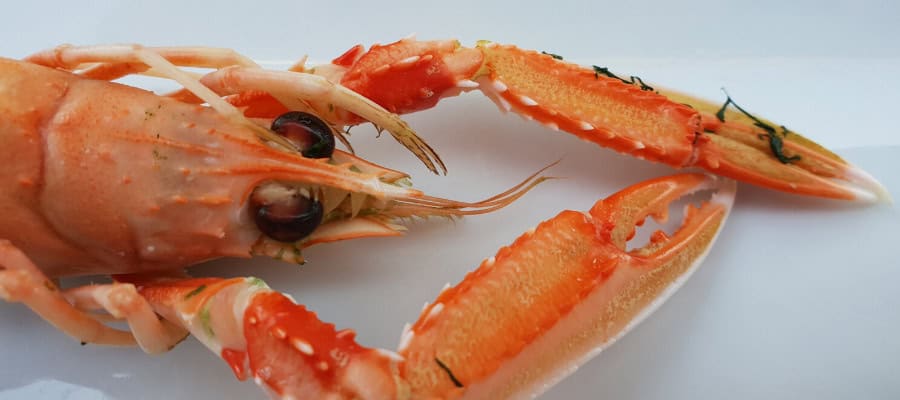
At a gut level, most of us consider humans’ lives far more significant than lobsters’ lives. But does this intuition just reveal a cognitive bias most of us have? Are there any good arguments to support the idea that lobster lives matter less?
Last month, a truck carrying over four thousand lobsters slid off the road and turned over in the small town of Brunswick, Maine. The driver emerged from the crash relatively unscathed, but his crustacean cargo, which fell onto the road, had to be destroyed. Before the month was out, PETA (People for the Ethical Treatment of Animals) sent a proposal to the state government for a monument memorializing the slaughter. Shaped like a five-foot high granite tombstone, it would display a picture of a lobster and be inscribed with the words “In Memory of the Lobsters Who Suffered and Died at This Spot, August 2018, Try Vegan, PETA.” PETA Executive Vice President Tracy Reiman said “PETA hopes to pay tribute to these individuals who didn’t want to die with a memorial urging people to help prevent future suffering by keeping lobsters and all other animals off their plates.” The state Department of Transportation turned the proposal down.
Now, I work in Maine, and I can confidently assure you that Mainers don’t take kindly to proposals to keep lobsters off their plates. In this case, both locally and nationally, PETA came in for considerable ridicule. To many people, the notion of a lobster memorial seemed utterly absurd. But why should this be? Why should we cast aspersions on a memorial to the killing of 4500 lobsters, but take seriously a memorial to the wanton murder of 2980 human beings on September 11, 2001? That’s a serious philosophical question.
Press a person on it, and they’re likely to say something like “Because they’re only lobsters, and people’s lives matter a lot more than lobsters’ lives.” That’s an intuitively plausible, or at least understandable, response. I think it’s safe to say that, at a gut level, most of us consider humans’ lives far more significant than lobsters’ lives. But “intuition” is just a fancy, philosophical name for cognitive bias. So, appealing to intuition to justify a position is just appealing to bias to justify that position. That’s not to say that biases are without value, only that they’re not good enough all on their own. In this case, citing intuition boils down to something like “I just can’t help believing that human lives matter a lot more than lobster lives do.” And that doesn’t get us anywhere.
Notice that our imaginary interlocutor doesn’t say “Human lives matter more to me than the lives of lobsters do.” That would express a subjective moral stance. Instead, she states that human lives matter more than lobster lives do, which is a claim about the objective value of human lives in contrast to that of lobster lives.
Over the centuries, philosophers have tied themselves up in knots (an activity that we philosophers excel at) to rationally justify the intuition—the bias—that human lives matter more than the lives of the “lower” animals. Judging from the continuing disputes in moral philosophy, it’s safe to say that they haven’t succeeded.
Notice my use of the scare-quoted word lower in the last paragraph. That word provides the key to unpacking the idea that lobster lives don’t matter much, if at all, in the scheme of things. The notion that some forms of life are higher or lower than others strikes a chord in many of us, but when you begin think about it, it’s perplexing. It’s not an idea that comes from (or is endorsed by) biological science. In fact, one of the most important philosophical implications of Darwin’s theory was the demolition of the idea that some organisms rank higher than others.
If we say that humans are higher than lobsters, we owe an explanation of in what sense they’re supposed to be higher. What’s at work here is what philosophers call the notion of intrinsic value. To get a hold of what’s meant by this, it’s useful to contrast intrinsic value with instrumental value. The instrumental value of a thing resides in its consequences—or, to put the point more crudely, in what it can get for you. Money is a good example. What’s the point of having money? Certainly not to just sit there and admire it, like one might do with Michelangelo’s David. The value of money is entirely instrumental. In contrast, the intrinsic value of a thing is its value in and of itself. For instance, some people think that happiness is intrinsically valuable. It’s not that we want to be happy because it leads to something else. We just want to be happy because…well… it’s good to be happy.
The people who think that PETA’s proposed lobster memorial is ridiculous are, I assume, happy to admit that lobsters have considerable instrumental value, as lobster fishing is a big part of Maine’s economy, but deny that lobsters have much if any intrinsic value.
The idea that some kinds of organisms are higher than others—in other words, the idea that the world of living things is organized as a hierarchy with those with the greatest intrinsic value at the top, those with the least value at the bottom, and everything else at one or another rank somewhere in-between—is known as the Great Chain of Being. For centuries, European scholars took for granted that the Great Chain provided the most accurate picture of the cosmos. Traditionally, God was placed at the apex of the hierarchy, because he is by definition the supremely perfect and infinitely valuable entity. And we Homo sapiens modestly placed ourselves not too far beneath him (“just below the angels”), because we suppose ourselves to have been fashioned in God’s image. In contrast, lobsters are relegated to quite a lowly rank in the pecking order, far below many other creatures. And that’s why they don’t count for much.
Where does the idea of the Great Chain of Being come from? According to the philosopher Arthur O. Lovejoy, the author of the immensely influential 1936 book The Great Chain of Being: A Study of the History of an Idea, it was cobbled together by philosophers in late antiquity, out of raw materials extracted from the writings of Plato and Aristotle. It persisted for centuries, and then faded out in the latter part of the eighteenth century as a scientific conception of species began to replace the older, prescientific one.
Lovejoy’s book is an extraordinary work of scholarship—a brilliant contribution to the history of ideas. But his story of the career of the Great Chain of Being just can’t be right. Here’s why.
First, remember that I began this essay talking about reactions to PETA’s proposed roadside lobster memorial. If, as I’ve suggested, those who’ve ridiculed the idea—and the related idea that we shouldn’t eat animals—did so because they believe that lobsters are a lower form of life, that shows that, far from having faded away towards the end of the eighteenth century, the notion of the Great Chain of Being is alive and well at the beginning of the twenty-first.
Couldn’t this attitude be chalked up to scientific illiteracy? Nope. Scientists—in fact, professional biologists—also regularly indulge in this sort of hierarchical thinking. Biologists Emanuele Rigato and Alessandro Minelli demonstrated this in a survey of more than 67,000 articles in major biological journals, and guess what they found? The pre-Darwinian language of “higher” and “lower” infects lots of biological journals, even evolutionary ones (the distinguished journal Molecular Biology and Evolution is the worst offender, with 6.1% of the articles surveyed using hierarchical language).
The other reason why Lovejoy’s story has got to be wrong is that it’s too parochial. Even if the Great Chain of Being is just a philosophical artefact (which it isn’t), it’s not a uniquely Western one flowing from the thinking of Aristotle and Plato. In fact, if you abandon this assumption, and look around in other traditions, you’ll find its footprint all over the place. The hierarchical conception of nature makes an appearance in the book of genesis, where God empowers humans to lord it over the beasts of the field, as well as in Indian and West African cosmologies. One of the most striking examples is found among the Aztecs, who can hardly be accused of drawing on the sages of classical Athens. According to the anthropologist P. R. Sanday, “Gods, humans, and animals were ordered according to a chain of being in which each segment participated in a common essence and depended on other segments to survive…,” and so:
The present version of mankind was…placed below the gods and above all other animals in the ladder of power, merit, and perfection. This ladder was revealed in the eating order. Lower orders of animals ate one another and plants, animals at all of them, and the gods ate humans to subsist.
I’ve explained why Lovejoy’s story can’t be right. It doesn’t account for the staying power of hierarchical thinking in human psychology, or it’s persistence in science, or its wide distribution across cultures. But I haven’t shared my view of what the right explanation is, and why it is so easy to think that Lobster lives matter far less than human lives. That’s going to be the topic of next month’s blog.
Listen to the Episode
No related shows found.